
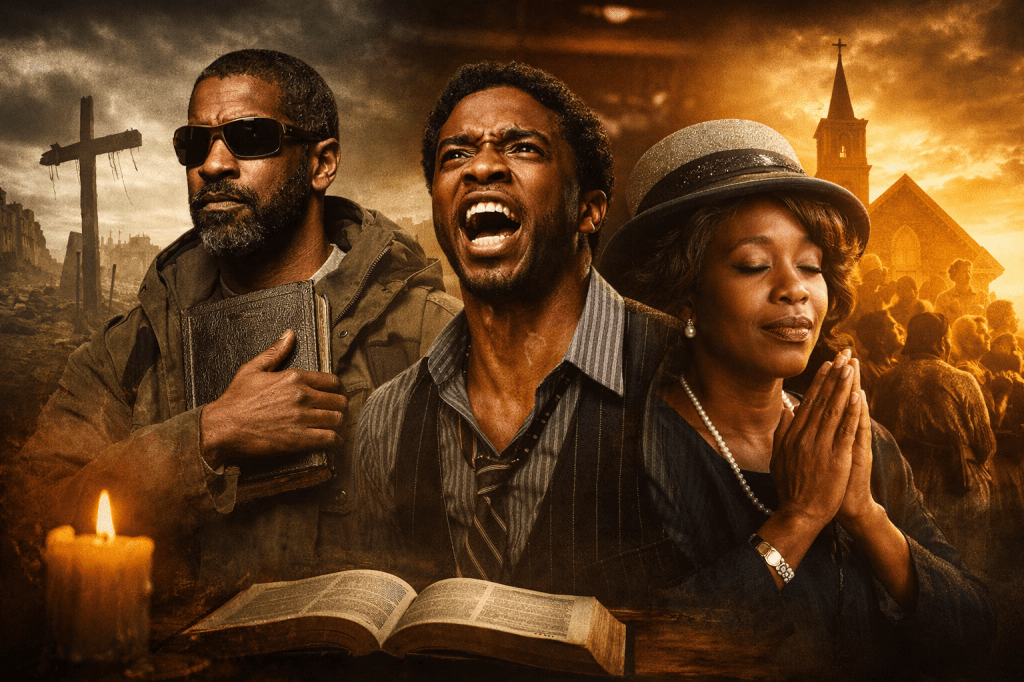
Black actors have long used film to explore faith not as a single belief system, but as a lived experience shaped by survival, injustice and community. On screen, God is not always a comfort. Sometimes He is a guide. Sometimes He is questioned. Sometimes He is simply present in the background of everyday life.
Three films. The Book of Eli, Ma Rainey’s Black Bottom, and The Family That Preys present distinct depictions of how Black characters connect with God, highlighting broader tensions in Black American spirituality.
Faith as direction
In The Book of Eli, Denzel Washington plays a lone traveler guided by faith through a post-apocalyptic America. Eli prays regularly, recites Scripture from memory and believes he is carrying out a divine mission: protecting the last remaining Bible.
The film presents faith as both spiritual and functional. Eli’s belief gives him purpose and discipline in a violent, lawless world. His adversary, who seeks the Bible for power and control, represents the opposite impulse of religion as domination rather than devotion.
The distinction is central to the film’s message. Faith, when practiced privately and lived through action, is portrayed as sustaining. When weaponized, it becomes destructive. Washington’s performance anchors the film’s reverent tone, positioning belief as endurance rather than spectacle.
While race is not overtly addressed, the symbolism resonates. Black faith, historically, has often operated as a survival mechanism, a source of structure and hope amid instability. The Book of Eli leans into that tradition, framing belief as a moral compass in a broken world.
Faith under interrogation
Faith is far more volatile in Ma Rainey’s Black Bottom. Chadwick Boseman delivers one of his most powerful performances as Levee Green, a gifted musician whose relationship with God is defined by anger, grief and disillusionment.
Levee openly challenges the idea of a just God, recounting a childhood shaped by racial violence and abandonment. His clashes with religious bandmates reflect a larger philosophical divide: whether faith offers comfort or excuses suffering.
The film does not resolve that tension. Instead, it treats doubt as an honest response to lived trauma. Levee’s anger functions as a lament, a refusal to accept easy answers. His rage mirrors a historical reality in which Black Americans have questioned Christianity’s promises while confronting the role it has played in justifying oppression.
The tone is confrontational and tragic. Faith is neither affirmed nor dismissed, but exposed. Boseman’s performance insists that questioning God is not the absence of belief, but evidence of how deeply belief once mattered.
Faith as practice
In The Family That Preys, directed by Tyler Perry, faith is quieter and more practical. The film centers on family, friendship and moral accountability, presenting belief not as ideology but as daily behavior.
Prayer, forgiveness and humility guide the story’s emotional arc. Characters driven by greed and betrayal face consequences, while those grounded in compassion and integrity find reconciliation. Faith here operates less as theology and more as an ethical framework.
The tone is accessible and affirming, consistent with Perry’s storytelling approach. God is present in conversations, decisions and acts of mercy rather than in moments of crisis or confrontation. For many viewers, this portrayal mirrors the lived experience of faith as routine, inherited and sustaining.
One faith, multiple truths
Taken together, the three films reflect the breadth of Black spiritual expression on screen. The Book of Eli frames faith as a divine mission. Ma Rainey’s Black Bottom interrogates faith through the lens of historical trauma. The Family That Preys presents faith as everyday moral grounding.
The contrast underscores a broader truth: Black spirituality is not monolithic. It is shaped by circumstance, class, history and personal experience. Sometimes belief offers clarity. Sometimes it invites confrontation. Sometimes it simply teaches people how to treat one another.
What unites these portrayals is their honesty. None of the films reduces faith to cliché. Instead, they allow belief and disbelief to exist in tension. In doing so, they reflect a long-standing cultural reality: for Black Americans, faith has always been complex, deeply personal and inseparable from survival itself.
 The Yaptain's Corner
Leave a comment