
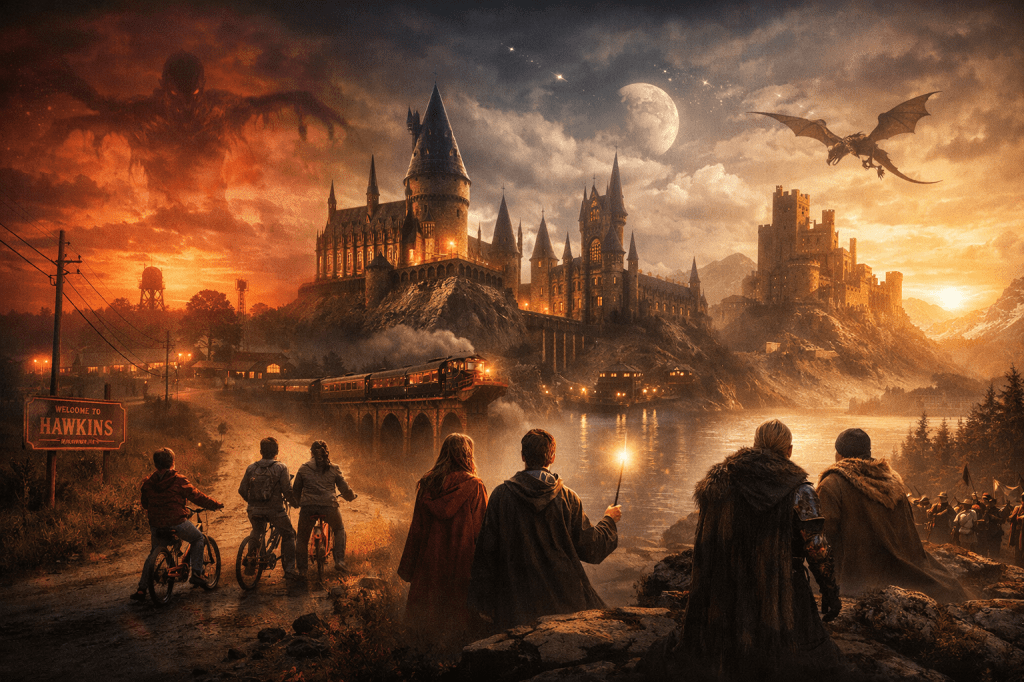
Three major franchises have beautifully shaped modern storytelling and continue to captivate people everywhere: Stranger Things, Harry Potter, and Game of Thrones. Even though each belongs to a different time and style, they share themes that resonate with audiences and highlight how fantasy and science fiction continue to inspire our culture today.
Worldbuilding uniqueness
In Stranger Things, a small town becomes the backdrop where supernatural elements blend into everyday life. Meanwhile, Harry Potter takes us into a well-established magical society filled with history, rules, and institutions. On a grander scale, Game of Thrones creates an intricate fantasy world, shaped by powerful dynasties, conflicts, and political struggles.
Despite their differences, all three franchises rely on detailed worldbuilding that helps viewers feel connected to their worlds and stories.
Friendship and loyalty tie stories together
Harry Potter’s trio is like a chosen family, bravely facing challenges together. In Stranger Things, a close-knit group of friends depends on each other when danger strikes. And even though alliances shift in Game of Thrones, the characters who value loyalty stand out as moral anchors, guiding the story.
Each franchise tackles conflict in its own special way. Voldemort drives much of Harry Potter’s story, while Game of Thrones features political rivals and the chilling threat of White Walkers. Stranger Things uses creature-based horror, like the Demogorgon and the Mind Flayer, and also shows how human institutions can sometimes cause harm.
These threats don’t just endanger physical safety; they also reflect deeper fears about trust, the loss of innocence, and the stability of communities.
Character growth
In Harry Potter and Stranger Things, young characters face hardships and gradually assume greater responsibility, revealing their journey toward maturity. In Game of Thrones, characters evolve by gaining political power through their experiences, conflicts, and survival skills.
The way fans engage with these stories also shows how much audiences have grown and changed. Harry Potter sparked a new wave of fandom in the early 2000s, Game of Thrones earned fantasy a respected place on television, and Stranger Things played a key role in shaping the streaming era while igniting nostalgia for 1980s culture.
Altogether, these franchises demonstrate how imaginative storytelling continues to influence entertainment and inspire cultural conversations across generations.
 The Yaptain's Corner
Leave a comment