
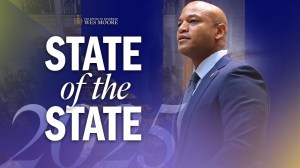
Annapolis, MD – In his third State of the State address, Maryland Governor Wes Moore delivered an impassioned speech outlining the state’s economic challenges and his administration’s vision for growth, equity, and resilience. Against a $3 billion budget deficit and economic uncertainty stemming from federal policy shifts, Moore emphasized the need for bold leadership and bipartisan cooperation.
Governor Moore acknowledged the state’s historic fiscal challenge, comparing it to the Great Recession. He warned of the impact of Washington’s recent economic policies, including a freeze on federal grants, and called for swift, strategic actions to close the deficit while ensuring economic growth and stability for Marylanders.“Our job is not simply to batten the hatches,” Moore said. “We must prove that when Maryland was tested, we collectively met this moment.”
Gov. Moore proposed a multi-faceted approach centered on industry growth, tax reform, and workforce development. He announced a $750 million investment to strengthen Maryland’s economic competitiveness, particularly in key sectors such as aerospace, defense, life sciences, AI, and biotech. Moore underscored the importance of making Maryland a leader in emerging industries, stating, “I want Maryland to be the capital of quantum and AI, clean energy, and biotech.”
In his infrastructure plan, Moore highlighted the expansion of the Port of Baltimore, which is projected to boost container capacity by 70%, generate over 8,000 jobs, and attract $1 billion in private investments. His administration also aims to invest $21 billion in essential transportation upgrades, covering bridge repairs, road resurfacing, and improvements to public transit. Moreover, Moore reiterated his dedication to aiding small businesses by decreasing corporate taxes and reforming Maryland’s tax code to foster a fairer, more business-friendly environment.
The governor reiterated his dedication to transforming Maryland’s public schools into the nation’s best, unveiling a groundbreaking $550 million investment—the largest ever in the state—to tackle teacher shortages and improve early education. Beyond education, Moore emphasized the importance of boosting job opportunities by enhancing workforce apprenticeships, aiming to create 5,000 new jobs, increasing funding for community colleges and technical training programs, and advocating for initiatives that promote housing affordability to help renters become homeowners.
Governor Moore called for legislative action to reform the state’s criminal justice system, especially regarding the barriers faced by returning citizens. He proposed legislation to broaden expungement eligibility, ensuring that past parole or probation violations do not permanently obstruct individuals’ access to employment and housing opportunities.“Our bill would change that so every time someone applies for a job or a home loan, they are not constantly shadowed by a decision they made decades ago,” Moore said.
Governor Moore’s speech served as both a policy guide and a rallying cry. He urged legislators to prioritize Maryland’s future over party divisions. “Let’s unite as one state and one people,” he stated. “Let’s confront this crisis with bravery.”
As Maryland navigates economic uncertainties and structural challenges, Governor Moore’s ambitious vision sets the stage for a year of critical decision-making and transformative policymaking. How do local residents feel about the governor’s priorities? Will his policies resonate with working families, small business owners, and educators?
I will continue to explore the local impact of Governor Moore’s agenda.
 The Yaptain's Corner
Leave a comment